

How Bags of Ethics and British Airways turned 16,000 airline uniforms into a blueprint for circularity
The ambitious upcycling partnership diverted eight tonnes of textiles from landfill.

Airlines refresh uniforms every 10-20 years, creating textile waste that rarely gets attention. British Airways’ partnership with Bags of Ethics shows a different approach: in its 2023 update, BA retired 16,000 uniforms and upcycled them into passport holders, luggage tags, and blankets instead of disposing of them. The collaboration diverted 8 tonnes from landfill, produced over 10,000 items, and developed infrastructure that could support similar efforts in other industries managing large volumes of end-of-life textiles.
When British Airways unveiled its new Ozwald Boateng-designed uniforms in September 2023, the airline faced a sustainability challenge: what to do with thousands of decommissioned Julien Macdonald uniforms that had served cabin crew and pilots for two decades.
The solution came through an innovative partnership with Bags of Ethics, that gave a second life to the retired uniforms by turning them into a range of practical, upcycled travel accessories.
The scale of the challenge
With 711,000 tonnes of textiles discarded annually in the UK alone, the aviation industry’s uniform waste represents a significant environmental concern. British Airways chose to tackle this head-on as part of its BA Better World sustainability strategy, partnering with Bags of Ethics, the world’s largest responsible manufacturer of reusable products.
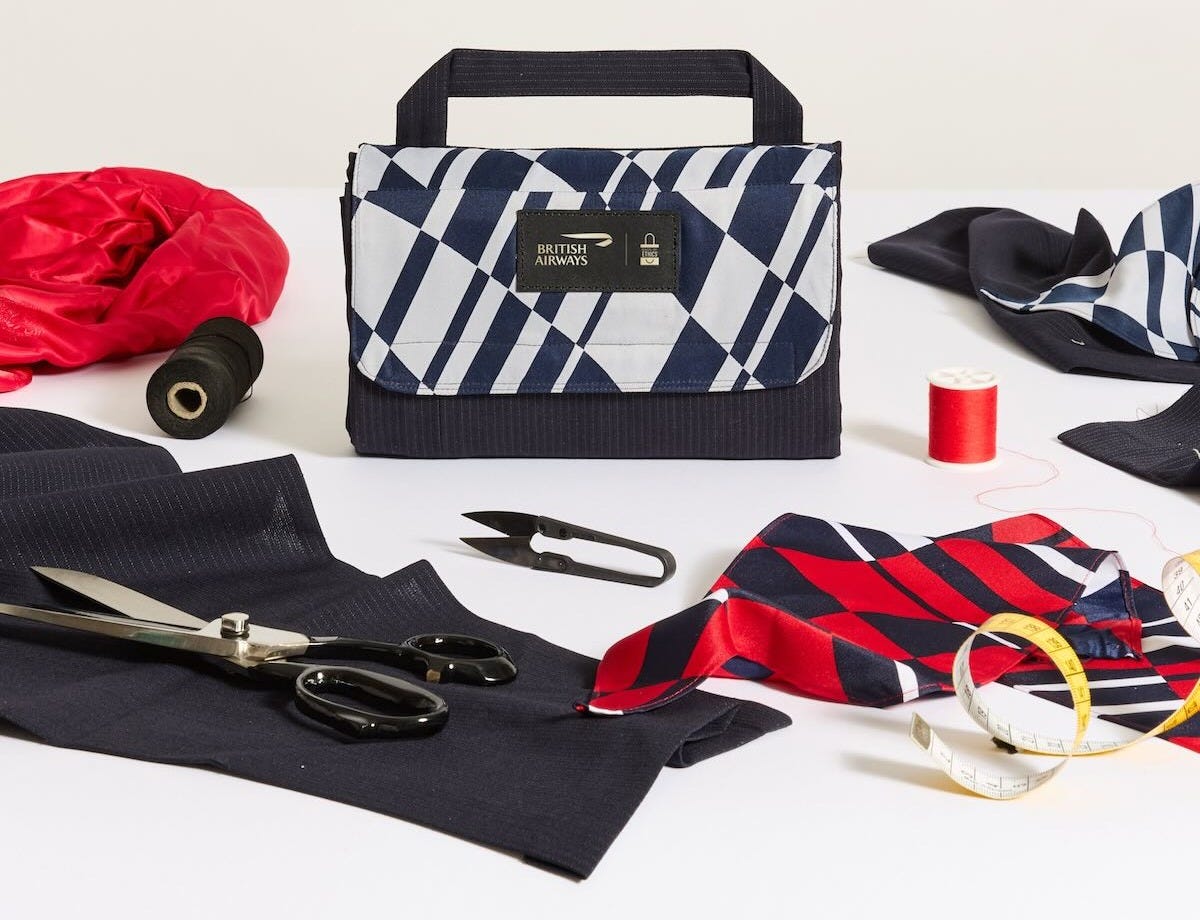
The project’s scope was ambitious: transforming over 16,000 legacy uniforms into functional travel accessories whilst diverting eight tonnes of textile waste from landfill. The result was more than 10,000 upcycled products, including passport holders, luggage tags, picnic blankets and document holders; items designed to be gifted to colleagues, clients and stakeholders.
Innovation through collaboration
Bags of Ethics, known globally for its reusable bags and ethical manufacturing, invested two years in developing the infrastructure to make large-scale upcycling feasible. This included introducing new sorting technologies, pattern design systems, and advanced disassembly techniques.
Each uniform underwent meticulous manual disassembly, with zippers, buttons, linings and embroidered badges carefully removed to preserve maximum usable fabric. Larger panels from blazers, trousers and skirts were used for products like picnic blankets, while smaller offcuts found new life as accessories including luggage tags.
At Bags of Ethics’ facility in Pondicherry, India, more than 80% of the workforce comprises women, who have been trained in these advanced remanufacturing methods. The process is deliberately manual to preserve fabric integrity and reduce the energy consumption involved in automated production, and takes about four times longer than making new items from scratch.

Overcoming challenges
The partnership required significant infrastructure investment and process innovation. The transportation of materials proved particularly challenging: garments needed careful packing and sorting by material type to facilitate quicker disassembly process. The company also had to navigate complex international customs regulations to enable finished garments to be imported, upcycled and re-exported without being classified as textile dumping. The finished products were transported primarily by sea to minimise carbon emissions.
According to Bags of Ethics, upcycling can eliminate 50-80% of emissions compared to virgin textile production by avoiding fibre cultivation, dyeing and finishing processes altogether.
While the company has so far focused on uniforms, the company recognises opportunities across other aviation textiles, from seat covers and carpets to cabin crew scarves and blankets. The model also holds potential for other industries such as retail, hospitality, and logistics, where large volumes of textiles are routinely discarded.
Looking forward
While Bags of Ethics acknowledges they haven’t yet tracked Scope 3 emissions and a detailed carbon footprint analysis remains to be undertaken, the benefits of the process cannot be overlooked.
The partnership between British Airways and Bags of Ethics demonstrates that large-scale textile upcycling is technically achievable within complex global supply chains. By combining responsible design, manual craftsmanship, and targeted investment in infrastructure, the initiative presents a replicable approach for managing end-of-life textiles.
As Dr R. Sri Ram, Founder of Bags of Ethics, notes: “This project has been transformative; from product design and supply chain innovation to responsible production. We hope it serves as a blueprint for circularity in business across industries.”
As more sectors look to integrate circularity into their business, the British Airways and Bags of Ethics model offers hope that transformation at scale can be achievable – turning what could have been a waste disposal problem into an opportunity for innovation, employment and environmental stewardship.