

How to build the financial architecture to scale SAF
From airline-backed venture funds to corporate Scope 3 buyers, a look inside the complex financial machinery emerging to bridge SAF’s gap between mandate and reality.

Sustainable aviation fuel (SAF) production doubled to 1.9 million tonnes in 2025 from the previous year. That milestone, delivered against a backdrop of new mandates, Trump-era policy disruption, and volatile feedstock markets, was a recurring reference point at this month’s SAF Investor London conference.
But across three panels on the first day of the conference, covering airline-backed venture capital, market intermediation, and public-market financial analysis, a more complex picture emerged.
The SAF industry’s next challenge is how to build the financial infrastructure to fund further growth and meet mandates.
Organising airline capital
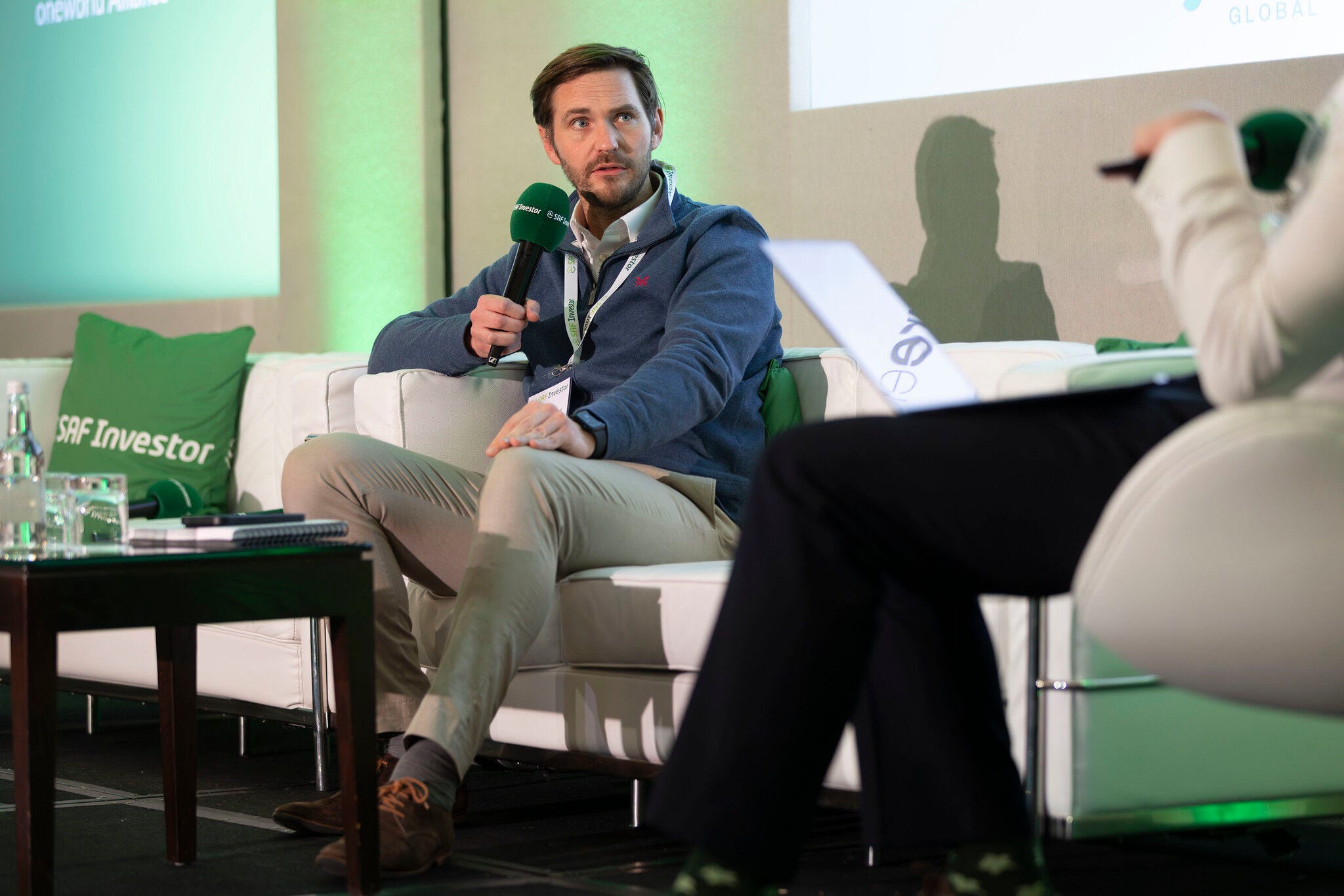
Matt Ridley, oneworld’s director of sustainability and innovation, opened the three investment-focused sessions by explaining why airlines needed a fundamentally different approach to SAF funding.
Airlines, he argued, are poorly optimised for venture capital. They operate with conservative risk profiles geared toward network planning and OEM procurement, not early-stage technology bets. Getting multiple carriers to agree on a single deal proves near-impossible.
“Airlines are much better at moving in a peloton,” Ridley said. “They’re much happier inside a herd.”
The solution was the oneworld Breakthrough Energy Ventures Fund, a dedicated SAF investment vehicle launched last year, in which Breakthrough Energy acts as general partner, making full-time investment decisions that airline executives could never commit to on a part-time basis. Seven of the eight airlines that joined had never made a fund investment before.
The fund is targeting $150-250 million and investing at Series A and B in technologies that could bring SAF costs down to parity with fossil fuel plus carbon price plus compliance costs.
Ridley was candid about why this matters: asking airline boardrooms to pay two to three times the price of conventional jet fuel is a losing proposition over the long term.
“I’ve been in those boardrooms, I’ve been in those meetings where you’re basically appealing to the benevolence of senior leaders as to why you should buy SAF over compliance,” he said. “Only through price can you really scale this industry.”
If Ridley addressed how capital is being organised at the top of the funnel, Natasha Mann, founder of Future Energy Global, described the plumbing being built in the middle. Mann is applying a similar aggregation model to SAF, matching long-term supplier offtakes with portfolios of airline and corporate buyers and managing delivery risk across both sides, much as a lessor manages aircraft placement risk.
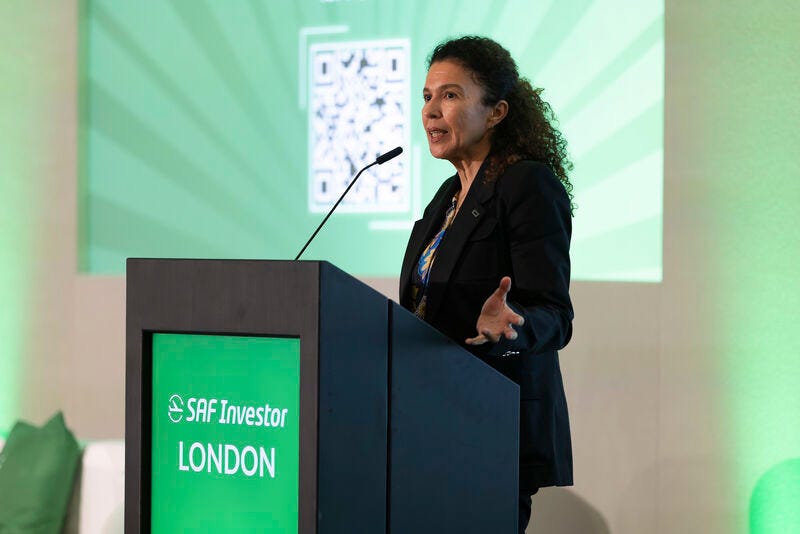
The company delivered 35,000 tonnes of carbon abatement and captured roughly 2% of the voluntary market in its first active year.
Landmark deals included a first-of-its-kind intermediary arrangement with Microsoft for Scope 3 certificates from Asia, multi-year offtakes with Gevo and Montana Renewables, and a book-and-claim pilot involving JetBlue, DHL, Atlas Air, SAS, and others.
The biggest headwind? A shortage of corporate Scope 3 buyers. In the voluntary market, corporates, not airlines, pay most of the SAF premium. But too few are buying, and the narrative shift from climate action to energy dominance has complicated the sales process.
Mann was philosophical about the Trump disruption: “All we’ve done is we’ve taken a few keywords out and changed them with others, like impact. But there’s no slowing down this business.”
She noted that purchasing decisions are increasingly moving from chief sustainability officers to chief procurement officers, a positive sign that SAF is becoming embedded in business operations, but one that demands a sharper commercial narrative around local economic impact, energy independence, and supply chain resilience.
The financial reality check
The third panel featured two financial analysts: Naisheng Cui from Barclays, who covers European energy majors, including Neste, and Adam Forsyth from Longspur Capital, who focuses on pre-production clean energy developers.
Forsyth set the tone by noting that what distinguishes SAF from other clean energy sectors is the existence of real, signed offtake contracts. “We still have companies coming to us with what I call the field of dreams fallacy. Build it and they will come. Well, no they won’t.”
Forsyth was equally blunt about the quality of some pre-contractual commitments. “LOI? Letter of imagination. MOU? Murmuring of unicorns.” The SAF sector, he said, has less of this problem than other parts of clean energy, which is a genuinely positive signal for investors.
Cui offered a sobering tour of the public market’s verdict on SAF, noting that Neste’s market capitalisation peaked at around €45 billion during the 2020 renewables boom, then collapsed to €7 billion by early 2025, although it has since tripled. The volatility illustrates both the sector’s promise and its exposure to margin compression, refinery incidents, and shifting regulatory signals. Half of Neste’s earnings still come from traditional refining, even though investors buy the stock for its renewable story.
On the demand side, Cui described fuel suppliers capturing significant margins as intermediaries rather than producers. He pointed to Shell, which took a €1.2 billion impairment on its 820,000-tonne SAF refinery in Rotterdam after shareholders pressured management to step back from production.
Instead, Shell has adopted what Cui called a “trading, not asset-backed” strategy: buying SAF cheaply from producers in Thailand and China, aggregating it, blending it with conventional jet fuel, and selling it to airlines at roughly three times the normal jet fuel premium. With only a handful of major fuel suppliers to choose from, airlines have limited room to shop around.
Forsyth highlighted the feedstock challenge facing the sector. The supply chain for biofuel-based SAF is fundamentally different from traditional oil refining. Neste sources from 600 suppliers across 60 countries, and hedging is extremely difficult when feedstock prices bear no correlation to the jet fuel price at which SAF is sold.
That demand for feedstock is very real was illustrated by one colourful example. “I don’t know if you’ve seen the news,” Forsyth said, “but in the Highlands of Scotland, there have been 147 thefts of used cooking oil bins from the back of fish and chip shops.”
The thread connecting all three
Taken together, the three panels painted a picture of an industry at an inflection point. Production is scaling: 1.9 million tonnes in 2025 is real. But the financial architecture around it remains underdeveloped.
Airlines need dedicated funds like oneworld-Breakthrough to channel risk capital into technology breakthroughs. The market needs intermediaries like Future Energy Global to create bankable offtakes backed by external balance sheets. And investors need the kind of granular, unsentimental analysis that Cui and Forsyth provide to separate signal from noise.
The common thread is that SAF cannot scale on goodwill or mandates alone. It needs functioning financial markets, with proper risk allocation, price discovery, and diverse sources of capital, to bridge the gap between where the industry is today and where it needs to be by 2030.