

How Europe plans to lead in aviation
Mastering the “Magic Three” - Insights from Clean Aviation Annual Forum 2026

The Clean Aviation Annual Forum 2026 in Brussels brought together some of European aviation’s most consequential voices to wrestle with the “Magic Three” challenge: how can Europe simultaneously achieve competitiveness, sustainability, and technological sovereignty?
I personally attended the forum, and what follows are the key insights from a day of frank, wide-ranging conversation spanning the European Union’s (EU) aviation strategy, the stubborn gap between innovation and commercialisation, infrastructure investment, sustainable aviation fuels (SAF), and what it will actually take to keep Europe at the front of global aviation over the next decade and beyond.
The EU’s role in strengthening aviation leadership
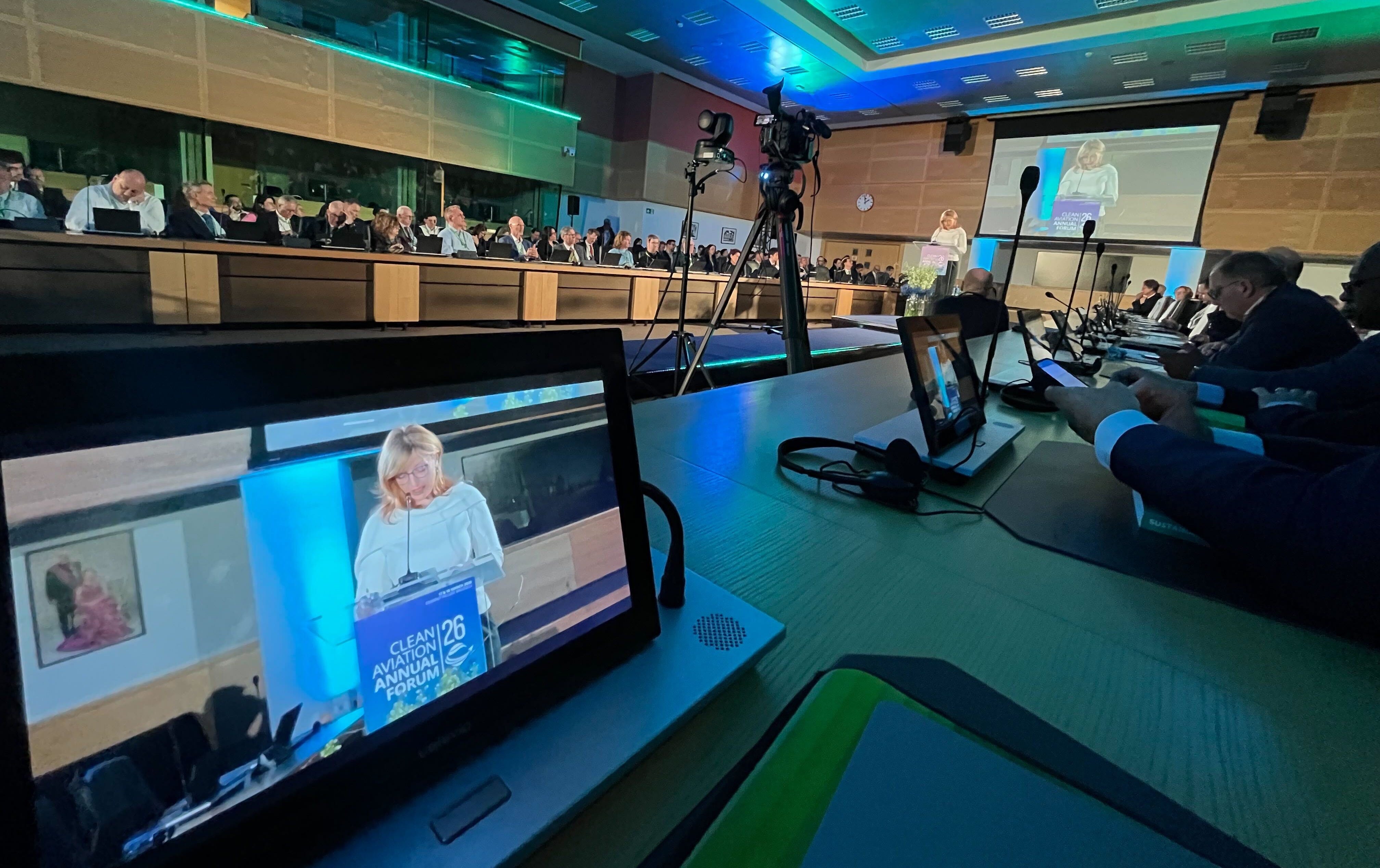
In a fireside chat that focused on Europe’s position in a rapidly evolving aviation landscape, Magda Kopczyńska, Director-General for Mobility and Transport at the European Commission (EC), reaffirmed Europe’s leadership in aviation, underscoring the region’s continued strength in aviation innovation.
On funding, Kopczyńska pointed to a proposal for two financial instruments aimed at better supporting innovation and scaling. These could sit within the next Horizon Europe program or the European Competitiveness Fund, with the Commission still working through how the two would coexist. The objective, she said, is to accompany companies “from the idea to the full market deployment”. She also pointed to the upcoming publication of a new EU aviation strategy spanning the entire ecosystem: infrastructure, airports, airlines and manufacturers. A formal “call for evidence” is due shortly.
The conversation closed on sustainability. Kopczyńska also emphasised the importance of staying the course on sustainability, pointing to the Sustainable Transport Investment Plan published in November 2025, as a way to boost investment in SAF. She also framed energy independence as an underlying concern for Europe: “This is the dependency that Europe really cannot afford to have for a long time.”
Competitiveness in aviation: policy driver or industry outcome?
The fireside chat was followed by a panel discussion that brought in four additional voices: Rémi Maillard, Executive Vice-President Engineering for Commercial Aircraft and Head of Technology at Airbus; Dorothea von Boxberg, CEO of Brussels Airlines; Christian Kunsch, CEO of Hamburg Airport; and Ivor van Dartel, CEO of Væridion, a European startup developing fully electric regional aircraft.
The gap between invention and commercialisation
When the wider panel convened, van Dartel offered the sharpest diagnosis of why mastering the “Magic Three” is harder than any policy document suggests. The issue, he argued, is not a lack of innovation, but an inability to translate it into commercial success. “Europe invents, America commercialises and China builds,” he said. “We need to commercialise more and we need to build more.”
He also highlighted the scale of the opportunity, particularly in short-haul travel: Europe has nearly 229 million passengers flying on routes below 500 kilometres, compared with just 80 million in the United States.
His argument was ultimately about how innovation is brought to market. Governments, he suggested, need to play a more active role in early demand creation. Drawing on examples from outside aviation, he cited Norway’s electrification of buses and ferries, where public institutions placed the first orders, helping to de-risk investment and unlock private capital.
He also pointed to a deeper structural issue in Europe’s financial system. “Half of the money on the NASDAQ is coming from European investors,” he said, arguing that without a more integrated European capital market, Europe risks continuing to build companies that ultimately grow elsewhere.
Operational gains now; transformational change later
von Boxberg offered a more immediate perspective on decarbonisation. For airlines, she explained, the quick wins sit almost entirely in day-to-day operations: single-engine taxiing, weight reduction wherever it can realistically be found, and aerodynamic improvements that can be applied to existing aircraft. At Brussels Airlines, this approach led to measures like optimising potable water loads by carrying only what is required for each flight rather than adhering to standard fill levels. While individually modest, these steps are practical and add up over time, she said.
She also highlighted the constraints shaping airline decision-making. European carriers, she argued, operate within a regulatory framework that can place them at a disadvantage relative to airlines outside the EU, underscoring the need for a more level playing field to remain competitive.
In terms of investment, von Boxberg was clear that fleet renewal remains the most dependable lever. Newer aircraft reduce fuel burn, affecting both emissions and costs. At the same time, she highlighted the challenge of slow technology cycles: aircraft entering service in the next decade will remain in operation for decades afterwards, emphasising the need to bring forward the next generation more quickly.
Sustainability is the purpose, not the constraint
Maillard pushed back against the framing of sustainability and competitiveness as inherently at odds. At Airbus, he said, the two are fundamentally linked. “Our purpose is to pioneer sustainable aerospace,” he said, emphasising that improving efficiency is central to both environmental performance and business outcomes. Fuel, he noted, remains a primary cost driver for airlines, so reducing consumption strengthens competitiveness while lowering emissions.
He also underlined the scale of change underway. The industry is approaching a new wave of technological disruption, spanning electrification and hybridisation, alongside advances in aerodynamics, materials and industrial systems. The question, in his view, is not whether these shifts will happen, but who will capture their value.
“I think it’s a very defining moment for the aviation industry if we take the right course now,” he said. “That’s the urgency… to take the right decision now that will define our aerospace industry for the coming decades.”
Infrastructure must be built for uncertainty
Hamburg Airport’s Kunsch focused on the realities of long-term infrastructure planning in a period of rapid technological change. Traditional assumptions no longer hold, he argued. Infrastructure designed to last for decades risks becoming outdated far sooner, as new propulsion systems and operating models emerge. “We cannot invest anymore in something that will last for 60 years,” he said, describing a shift towards a more modular approach: smaller, incremental investments that can be adapted as technology matures. While this may increase overall costs, it reduces the risk of locking capital into assets that may need to be replaced within five to ten years.
His broader view was that uncertainty must not become an excuse for inaction. Investment decisions will have to be made with incomplete information, and then revisited as conditions change.
On SAF, Kunsch was direct about the gap between ambition and delivery. He pointed to the disconnect between regulatory signals and industrial readiness: while policy frameworks are in place, the funding required to scale production has not followed at the necessary pace. In Germany, he noted, budgets had been identified but remain insufficient to enable a meaningful ramp-up of industrial capacity. The result is a growing mismatch between targets and supply. “If I set the framework and if I set the directions, then I also need to provide the funding. Otherwise it’s not going to happen,” he said.
The panel closed without easy answers, which is perhaps the most honest outcome for a challenge of this scale. Europe’s aviation sector has clear strengths in research, manufacturing and sustainability ambition; the task now is to translate that into commercial scale and financial momentum.