

Could Sustaera’s electric heating approach solve DAC’s cost problem?
North Carolina startup combines cheap sorbents with direct electric heating, betting that engineering simplicity will bring carbon capture below $100 per tonne.

⚡ In a nutshell
Sustaera has developed a Direct Air Capture (DAC) system that uses direct electrical heating rather than steam to release captured CO2.
The company claims this approach can achieve three to five times lower capital costs than existing DAC technologies, with 90%+ heating efficiency compared to roughly 40% for conventional thermal systems.
Combined with a sorbent material that costs less than $10 per kilogram (compared to thousands of dollars per kilogram for competitors), CTO Cory Sanderson says the company sees a credible path to sub-$100 per tonne carbon removal by the early 2030s.
Sustaera plans to build a commercial pilot in North America next year, with Stripe and Shopify as early credit buyers.
For aviation, Sustaera positions itself as a potential CO2 feedstock provider for synthetic jet fuel production, and as a source of DAC-backed carbon removal credits that offer the permanence and measurability that traditional offsets have failed to deliver
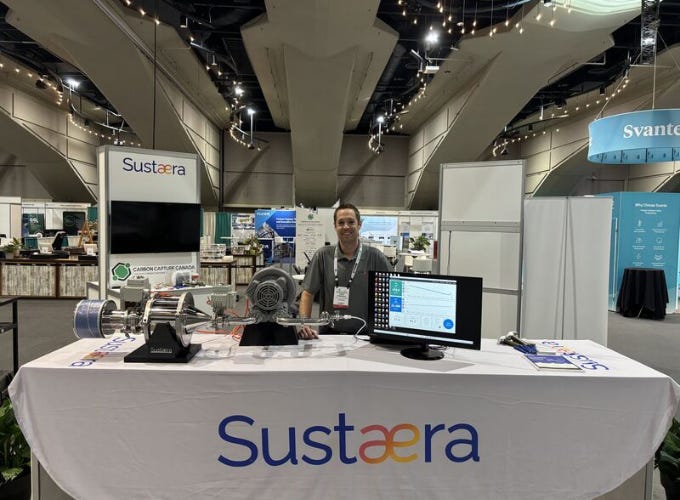
North Carolina-based Sustaera has developed a Direct Air Capture (DAC) system that it says can remove CO2 from the atmosphere at three to five times lower capital cost than existing technologies.
The company’s proprietary approach combines a low-cost solid sorbent with direct electric heating, eliminating the steam-based systems that most DAC plants rely on, and claims to have achieved 90%+ heating efficiency in its lab, compared to roughly 40% for conventional thermal methods.
If those numbers hold at scale, Sustaera believes it has a path to sub-$100 per tonne carbon removal, the threshold widely regarded as the point where DAC becomes commercially viable. The company is backed by Breakthrough Energy Ventures, the US Department of Energy, and the XPRIZE for Carbon Removal, and has existing credit contracts with Stripe and Shopify.
This comes as the wider DAC industry is under scrutiny for its cost projections. But in an interview with Sustainability in the Air, CTO and co-founder Cory Sanderson made the case that Sustaera’s advantage comes not from a single lab breakthrough, but from an engineering approach shaped by his 12 years building industrial-scale gas separation plants at carbon capture company Air Products.
“You need to go and find the market and the problem first and then develop the product and the solution that goes for that,” Sanderson said. “That’s the approach that we took.”
The electric jacket
Most solid sorbent DAC systems use steam heat to release captured CO2 from the sorbent material.
Sustaera uses direct electric resistive heating instead, and the distinction matters more than it sounds. In a steam-based system, you heat an entire chamber to release the CO2. Sanderson compares it to heating your whole house when all you really need is to keep yourself warm.
“This is almost like putting a jacket around you that has a little electric heater, and that’s just heating you,” Sanderson explained. “You’re not heating the whole home.”
In technical terms, Sustaera’s sorbent and its electrical heating element are in close contact. Power goes in, the sorbent heats up almost instantaneously, CO2 is released, and the system swings back. The surrounding gas barely rises in temperature.
Sustaera claims this approach achieves heating efficiency of 90%+ compared to around 40% for conventional thermal systems.
An important distinction: that 90% figure refers specifically to the conversion of electricity to heat at the sorbent, not to total system energy consumption per tonne of CO2.
A cheaper sorbent
The material that actually grabs CO2 from the air is often the most expensive component in a DAC system. Sustaera uses an amino acid salt, a different class of sorbent from what others in the industry employ.
The amino acid salt has the amine group that attracts CO2 at low concentrations, but it is tethered to a different chemical group that gives it greater durability, meaning it can withstand more heating cycles before degrading.
“We can get years’ worth of our sorbent in operation before we recommend refurbishing it,” Sanderson said. Refurbishment is a simple washing and recoating process using widely available materials.
The cost difference is significant. Sanderson said Sustaera’s sorbent costs less than $10 per kilogram, compared to thousands of dollars per kilogram for some competing solid sorbents. That is a 10 to 100x cost advantage on a critical component.
The $100 question
The sub-$100 per tonne figure has been the DAC industry’s stated goal for years. Few companies in this sector have detailed a credible path to get there.
Sanderson believes Sustaera’s combination of lower capital costs, from combining the adsorption and desorption systems into a single unit, and lower operating costs from electric heating puts the company on that path.
“Our system is like an HVAC system. It just runs. You set it and forget it,” he said. “It doesn’t need someone to sit there and babysit it to make sure the boilers are at the right temperature and pressure.”
Sanderson’s timeline is to reach sub-$100 per tonne within five years, at a scale of 50,000 to 100,000 tonnes of CO2 removal, achievable after building and iterating on a few modular units.
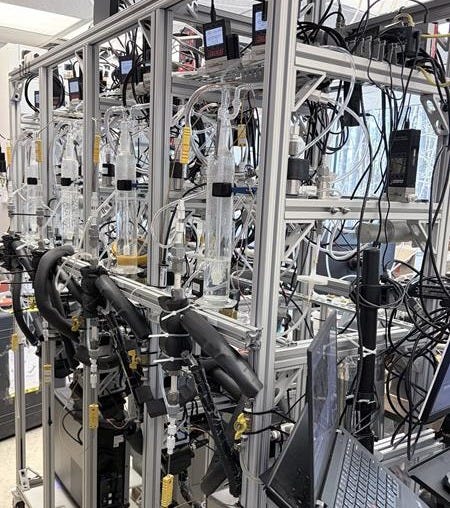
The behind-the-meter play
One of the more interesting elements of Sustaera’s strategy is how it plans to access cheap power.
Because the system is all-electric and can start up in minutes, it does not need baseload power. It can run on intermittent renewable energy, solar, wind, or a combination, connecting directly behind the meter at a generation site.
In the US and globally, there are massive queues for renewable energy projects waiting for grid interconnection. Those projects generate power but cannot yet sell it to the grid.
“What our system does is we could be building at that same time with someone waiting in the queue, doing carbon removal, maxing out on our system, taking CO2 out of the air, providing an additional revenue stream before a renewable project is able to go to the grid,” Sanderson said. “That’s a totally different thing.”
The modular design makes this work. A facility contains multiple separation units that can be turned on individually. If only a fraction of the available power is flowing, only a fraction of the units run. There is no penalty for stopping and starting.
What it means for aviation
Sustaera’s first market will be permanent carbon removal through sequestration, working with technology-agnostic project developers like Deep Sky. The company already has carbon removal credit contracts with Stripe and Shopify, and plans to build a commercial pilot in North America with operations beginning in 2027.
But for aviation, the longer-term play is twofold. Captured CO2 is a key ingredient in synthetic jet fuel, and Sustaera is positioning itself as a feedstock provider to e-fuel producers.
“We are a feedstock provider,” Sanderson said. “Anyone that’s interested, we’re happy to have those conversations.”
DAC-backed credits also offer airlines something traditional offsets have failed to deliver: permanence and measurability. Sanderson acknowledged that DAC credits will initially cost more than forestry-based offsets. But he argued the certainty is worth the premium.
“DAC is a known, measurable thing that we will be able to show and prove,” he said. “This is exactly how much was taken out.”
What to watch
Two things to watch as the company moves toward its commercial pilot.
First, the total system energy figure. The 90%+ heating efficiency is meaningful but measures only one part of the process.
Second, the sub-$100 pathway depends on cheap renewable power, sorbent durability over years of operation, and the modular units performing as expected in real-world conditions.
Sanderson’s industrial background, Sustaera’s engineering-first approach, and the behind-the-meter model are worth taking seriously. But the question, as always is whether the projections survive contact with reality.
The 2027 pilot will be the first genuine test.