

Why Boeing believes that SAF is "the only game in town"
Amid the hydrogen and electric hype, a senior executive argues that physics, timing, and infrastructure leave sustainable aviation fuel as the sole near-term path to scale.

Boeing expects sustainable aviation fuel (SAF) to do most of the heavy lifting in aviation’s journey to reduce net-zero emissions, arguing that physics, infrastructure realities, and commercial pressures leave few alternatives capable of scaling fast enough in the short to medium term.
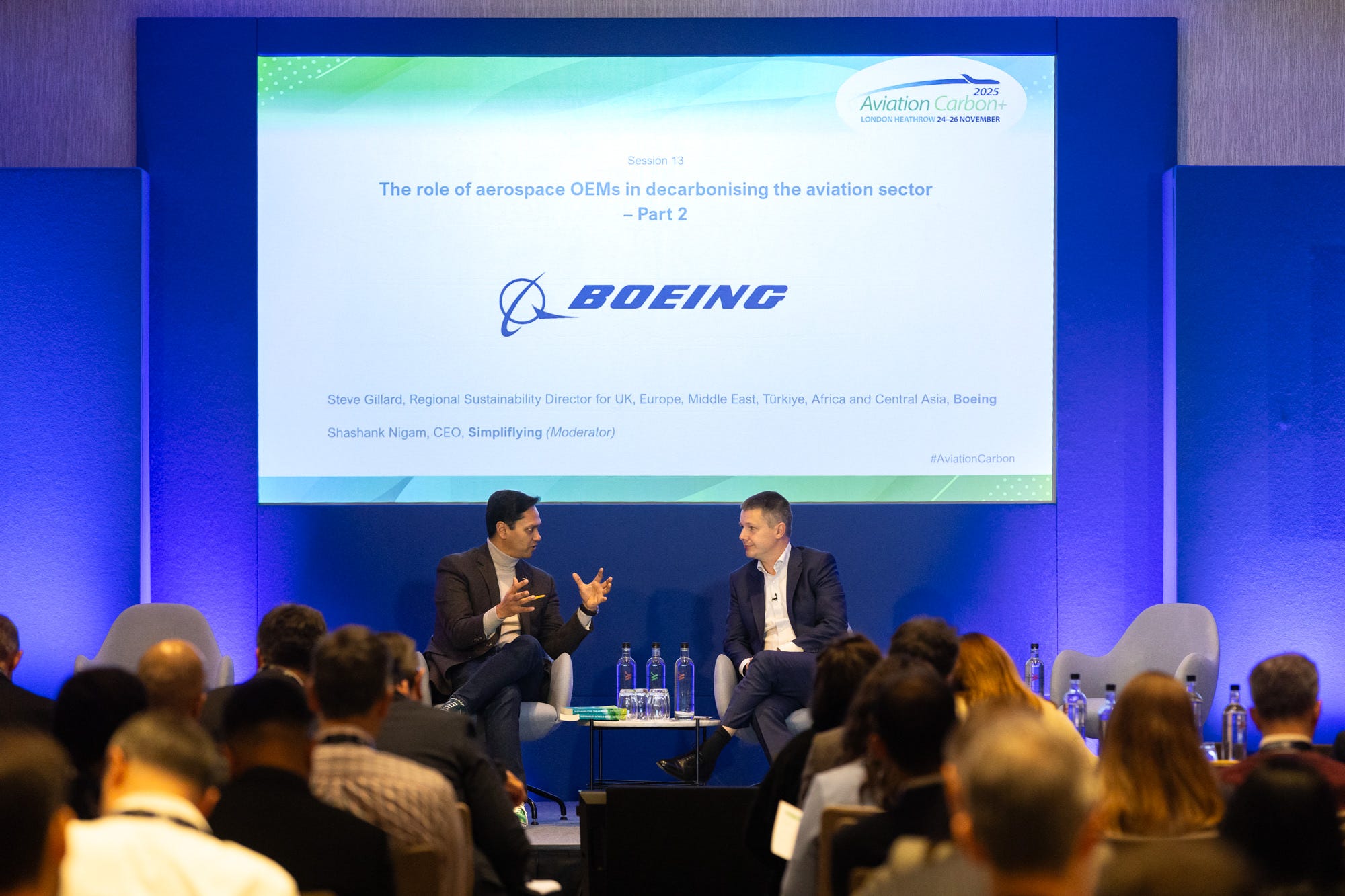
Speaking at the Aviation Carbon conference in London, Steve Gillard, Boeing’s Regional Sustainability Director for Europe, the Middle East, Africa, Türkiye, and Central Asia, said SAF remains “the only game in town” in terms of available renewable energy options. Electrification and hydrogen may play future roles, he said, but neither can deliver sector-wide decarbonisation at the required pace.
Moderator Shashank Nigam, founder and CEO of SimpliFlying, set the tone by noting that “airlines are largely reliant on SAF and market measures to reduce emissions,” and asked Gillard whether carriers were now blending multiple approaches.
Gillard replied that this is not a hypothetical direction of travel. “I’m seeing it today,” he told the audience, adding that physics limits the choices available, forcing operators to combine multiple strategies, including SAF, efficiency upgrades, and carbon removals, depending on their fleet and geography, among various elements.
Costs and context
Nigam also asked about the persistent ‘green premium’ attached to low-carbon fuels, asking Gillard whether SAF and removals would ever shed their price disadvantage. Gillard cautioned against generalisations, pointing to wide regional variations.
In parts of Sub-Saharan Africa, he said, HEFA-based SAF can already compete with traditional Jet A1 because of existing Jet A1 logistics and distribution costs. In some defence applications, where fuel transport consumes vast quantities of fuel, power-to-liquid pricing can appear attractive rather than prohibitive. “Economics are relative,” Gillard said, adding that policy remains critical to closing the premium.
On whether OEMs could accelerate price convergence, Gillard argued the issue is not just technology but timing; as renewable electricity and hydrogen costs fall, pathway economics will shift. However, the trajectory will vary: some routes to SAF will scale cleanly; others, he implied, may struggle without regulatory support.
OEMs at the fulcrum
Nigam raised the role of manufacturers in bringing novel fuel pathways to market. Gillard responded that Boeing’s efforts span technology testing and work with ICAO and partners such as the Roundtable on Sustainable Biomaterials (RSB) on the development of sustainability standards.
The company helps shape certification frameworks, ensuring new fuels meet safety criteria and are deployable on existing aircraft. “Safety and quality come first before we look at anything else,” he stressed.
The company also seeks to spotlight SAF technologies it sees as viable at scale. Gillard cited Firefly Green Fuels (which converts sewage into jet fuel) from the UK as an example of unconventional feedstock innovation with global potential. “Every human, he joked, produces the equivalent of around five litres of jet fuel a year, a feedstock that keeps on giving.”
Cascade: Bringing scenarios to life
Nigam referenced recent Boeing–SimpliFlying workshops, in which participants from aviation, policy, and energy used the Boeing Cascade Climate Impact Model to test assumptions on emissions reduction pathways.
Gillard highlighted that Cascade gathers publicly available data and is open and free for everyone to use. It allows users, including airlines, investors, and regulators, to adjust assumptions on reducing emissions and see potential outcomes immediately. One such outcome that has surprised many participants across workshops: swapping large shares of SAF for hydrogen without changing hydrogen’s upstream emissions can cause total emissions to rise by 70%.
“You then have to ask why,” Gillard noted. The explanation lies in how most hydrogen is produced today, with only a small proportion being clean hydrogen.
Regional realities
According to Gillard, every region has its unique conditions: Africa holds immense feedstock availability and sees SAF export opportunities in Europe; the Middle East combines solar potential with energy expertise; Türkiye and Central Asia are aligning with Europe while exploring local production capacities.
The discussion closely mirrored themes explored in the second volume of the book, Sustainability in the Air, in which Boeing’s multi-faceted approach to aviation decarbonisation is detailed around their “SAF&” philosophy – advancing SAF as the primary lever for emissions reduction, while continuing to explore advanced technologies, operational efficiency, and market-based measures.

In the book, Boeing executives argue that while SAF will carry most of the load, no single solution can achieve net zero in isolation, a point echoed repeatedly in Gillard’s remarks.
In the fireside chat, Shashank Nigam noted that the industry is now moving from high-level ambition to practical implementation, where questions of cost, scale, and interoperability are overtaking ideology.
Gillard’s assessment serves as both a grounding reality check and a clear call to action. The roadmap to 2050 is being written not by a single breakthrough, but by the steady, collaborative scaling of sustainable fuel, guided by smart policy and grounded in regional truths.