


In this episode of our ‘Sustainability in the Air’ podcast, Adam Klauber, Chief Sustainability Officer at World Energy, speaks with SimpliFlying’s CEO Shashank Nigam and shares how the book-and-claim model has evolved from a concept to a practical mechanism for scaling corporate demand for sustainable aviation fuel (SAF).
Klauber has been closely involved throughout the SAF book-and-claim evolution: from early work exploring how airports could accelerate SAF uptake, to the development of the SAF Certificate Framework through Clean Skies for Tomorrow, and ultimately World Energy’s decision to sell directly to corporate customers, helping connect voluntary demand with real-world SAF supply.
Here are the key highlights of the conversation:
How co-claims unlocked multiple funding sources (8:53)
The SAF Certificate Framework and co-claims (10:36)
Building SABA: Uniting corporate buyers (11:31)
Behind the scenes of the book-and-claim system (19:19)
Why airlines initially resisted book and claim (21:25)
DHL’s SAF commitment before customer contracts (25:07)
Microsoft’s approach: Scope 3 credits first (26:08)
Insetting vs offsetting: Addressing moral hazard (30:48)
Bankable offtakes (36:13)
Rapid Fire! (42:47)
Keep reading for a detailed overview of the episode.
Why book-and-claim matters for closing SAF’s funding gap
Aviation’s path to decarbonisation faces a fundamental economic challenge: the cost premium for SAF remains prohibitively high, and airlines’ thin profit margins mean they cannot shoulder this burden alone. Book-and-claim has emerged as a practical mechanism to unlock new sources of funding by enabling corporate customers to pay for emissions reductions in their supply chains.
The framework builds on lessons from renewable energy certificate markets for solar and wind, where corporate buyers funded new generation capacity through power purchase agreements. However, aviation required a critical innovation that diverged from the electricity sector: the ability to split claims between multiple parties.
“As one buyer-side participant put it, ‘I don’t really need the direct emissions benefits. I’m not an airline. I just want Scope 3 claims,’” Klauber recalls, describing a past Clean Skies for Tomorrow meeting. “That was the moment it clicked. People said, ‘We need both. We need a parallel system that recognises airlines for their direct emissions reductions, and their customers for the supply chain reductions and Scope 3 claims.’”
This co-claims approach seeks to address a practical challenge for buyers: most companies fly across multiple airlines, making it difficult to concentrate purchases through a single carrier. By purchasing SAF certificates tied to verified deliveries, corporates can align claims with their total air-travel footprint, while sending a clearer demand signal upstream to producers.
5 takeaways from the conversation
1. Early lessons from airport-led SAF initiatives
Klauber’s involvement in SAF market design began at RMI in 2015, where he was asked a deceptively simple question: how do you pay for SAF at scale when it still carries a significant cost premium? One early avenue explored was an airport-led approach at Seattle-Tacoma International Airport, aimed at embedding a 1% SAF requirement into airline-airport agreements.
“The Seattle-Tacoma effort got everyone on board, including the port commissioners,” Klauber explains. “They said, ‘We’re going to put it into effect, and we’re going to require 1% SAF.’ As you can imagine, it caused a bit of a kerfuffle.”
That momentum, however, soon ran into industry resistance, and the proposal did not move forward, says Klauber. Still, it left a simple, unresolved question: if SAF could not be mandated, how would the cost premium be covered?
2. Building the framework: from RSAF to SAFc to SABA
Those early efforts pushed Klauber to explore certificate-based models for aviation, taking cues from the renewable electricity markets. In 2018, he worked on creating RSAF (Resilient Sustainable Aviation Fuel), a certificate-style credit intended to capture the emissions benefit of SAF. “They’d be credits that could potentially be sold to end users, such as corporations flying on the aircraft or shipping cargo,” he explains.
That line of thinking later fed into work under Clean Skies for Tomorrow, where Klauber led the Demand Signal Group and contributed to the development of what would become the SAF Certificate Framework. Published in 2021, it outlined how SAF certificates could work in practice, including a “parallel system” so that airlines and corporate buyers could both be recognised for the emissions reductions.
With the certificate framework in place, the next step was to create a reliable pool of buyers. Klauber began exploring the idea of a buyers’ coalition, and worked with partners to establish the Sustainable Aviation Buyers Alliance (SABA), so companies could participate at scale, despite the fact that SAF registries and formal accounting rules were still taking shape.
“We needed to work with industry leaders who weren’t afraid to move ahead before all the infrastructure was in place,” Klauber says. “There was no registry and no firm accounting rules. So we needed hyperscalers bold enough to step into the space even without those pieces.”
3. Microsoft and DHL: different paths to early adoption
In 2023, Microsoft signed a landmark 10-year contract to purchase sustainable aviation fuel certificates (SAFc) from World Energy. This made Microsoft one of the first corporates to act on the emerging SAFc model.
Microsoft initially focused on Scope 3 credits rather than waiting for the operational pieces needed to allocate Scope 1 benefits. “They said, you know, maybe we shouldn’t even bother with the Scope 1 credits [right now], because it’ll take time to figure out which airline is going to buy,” Klauber recalls.
DHL took a different route when they signed a 7-year partnership with World Energy to purchase 668 million litres of SAF via SAF certificates. The company committed early and put agreements in place before it had secured matching commitments from its cargo customers, shares Klauber.
“They had the foresight to… act on behalf of their customers even before they had those commitments,” he explains. That meant DHL could later offer SAF products to customers with supply already locked in, rather than trying to source it after demand had materialised.
4. Insetting vs offsetting
A book-and-claim system for SAF can be used to support what is often described as “insetting”: emissions reductions delivered within aviation’s own value chain, with the environmental attribute transferred through certificates rather than by moving physical SAF to a specific departure airport.
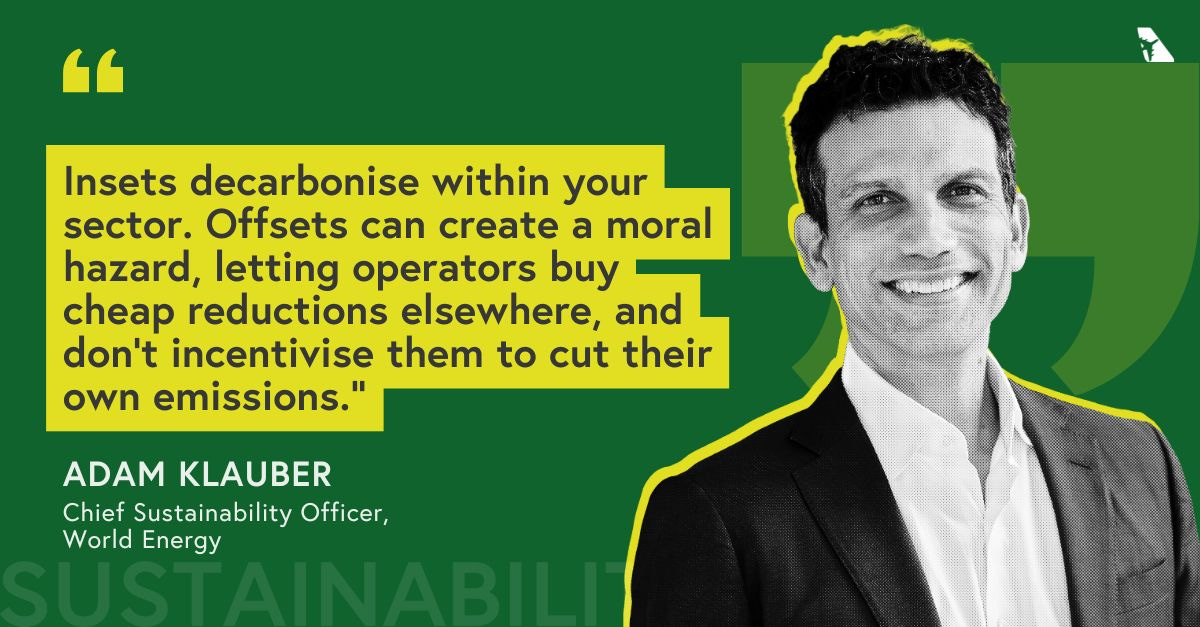
This distinction from offsetting is crucial. “There’s a question of moral hazard if you buy an offset, because it’s an emission reduction that’s not attached to aviation,” Klauber explains. “You can get reductions at the lowest cost, but it doesn’t incentivise the emitter to reduce their emissions, because offsets are often far cheaper than cutting emissions in their own operations.”
He points to Etihad’s flight to COP27 as a practical example. Rather than transporting SAF from Los Angeles to Washington Dulles, Etihad purchased certificates linked to SAF delivered at LAX. “We had the trucks lined up and we had a partner supplier that could have helped us,” Klauber recalls. “But Etihad agreed it did not make sense. They said, ‘Let’s create the first net zero flight.’”
The logic was straightforward: deliver SAF where blending and logistics already existed, then use book-and-claim to transfer the emissions benefit to the flight that needed it. Etihad also purchased additional SAF certificates, beyond those linked to the flight’s fuel use, to cover the remaining lifecycle emissions.
5. Bankable offtakes: making SAF projects financeable
For SAF producers, the hurdle is not only technology or feedstock supply, it is also finance. Klauber argues that even when projects look credible on paper, lenders still need confidence that someone will pay the premium for the fuel over the long term.
“The banks are very cautious; they want to manage risk,” he says. “And the number one risk, besides technology for SAF, is commercial risk because banks need to see: is there willingness to pay? Do you have a credit worthy counterparty?”
Airlines, he argues, are rarely able to provide that level of reassurance on their own. “The margins are so low and the industry has been challenging for a while, so we need the higher credit rating customers. Hence, [we need] the Microsofts of the world,” Klauber notes.
Along with RMI, World Energy recently co-authored a report titled Blueprints for Bankability, which offers a practical guide to accelerate SAF offtake agreements and reduce the friction that slows down project finance. The playbook comprises design principles that stakeholders can use to build SAF contracting ecosystems that support long-term investment.

In parallel, World Energy and RSB have launched the Market Acceleration Indicator (MAI), which is designed to support the scale-up of SAF by providing recognition of long-term environmental attribute certificate (EAC) offtake agreements. These agreements will be verified and reflected in RSB’s Book & Claim System, allowing SAF buyers and producers to demonstrate robust demand signals that support investment and financial decision-making.
For World Energy, the goal is not to build a closed system. “We believe these frameworks will be useful for us, they’ll be useful for our competitors, and ultimately they’ll make the industry work,” Klauber says. “Because no one wins when there’s just a trickle of SAF supply.”
Get our new book
Our new book Sustainability in the Air: Volume Two is now available for purchase on Amazon. Learn more about the startups, strategists, and sceptics working to close the gap between growth and green ambition.
‘Sustainability in the Air’ is the world’s leading podcast dedicated to sustainable aviation. Through in-depth conversations with top aviation leaders, we break through the clutter and provide a clear roadmap for a net-zero future.


