


In this episode of our ‘Sustainability in the Air’ podcast, Rachel Gardner-Poole, GAIN steering group chair and sustainable aviation consultant at NATS, speaks with SimpliFlying’s CEO Shashank Nigam about how a global collaboration of air navigation service providers is optimising flight paths to deliver carbon savings today.
The collaboration is helping build GAIN (Green Aviation Insights), the first global benchmarking, reporting and collaboration platform that enables Air Navigation Service Providers (ANSPs) to measure their airspace efficiency and identify ways to reduce emissions.
Here are the key highlights of the conversation:
Why communication gaps cost airlines fuel and emissions (6:59)
GAIN’s dual purpose: collaboration and dashboard tool (8:49)
What is airspace efficiency? (11:23)
The conservative impact: 450,000 to 9 million tonnes of CO2 savings (16:15)
How GAIN works without data sharing barriers (20:17)
Future expansion: contrails, partnerships and scaling up (21:11)
Addressing greenwashing concerns with real data (31:05)
Rapid Fire! (35:00)
Keep reading for a detailed overview of the episode.
How airspace efficiency can offer immediate emissions reductions
Unlike technologies that require years of development and certification, optimising flight paths can immediately reduce fuel burn and emissions using systems already in place.
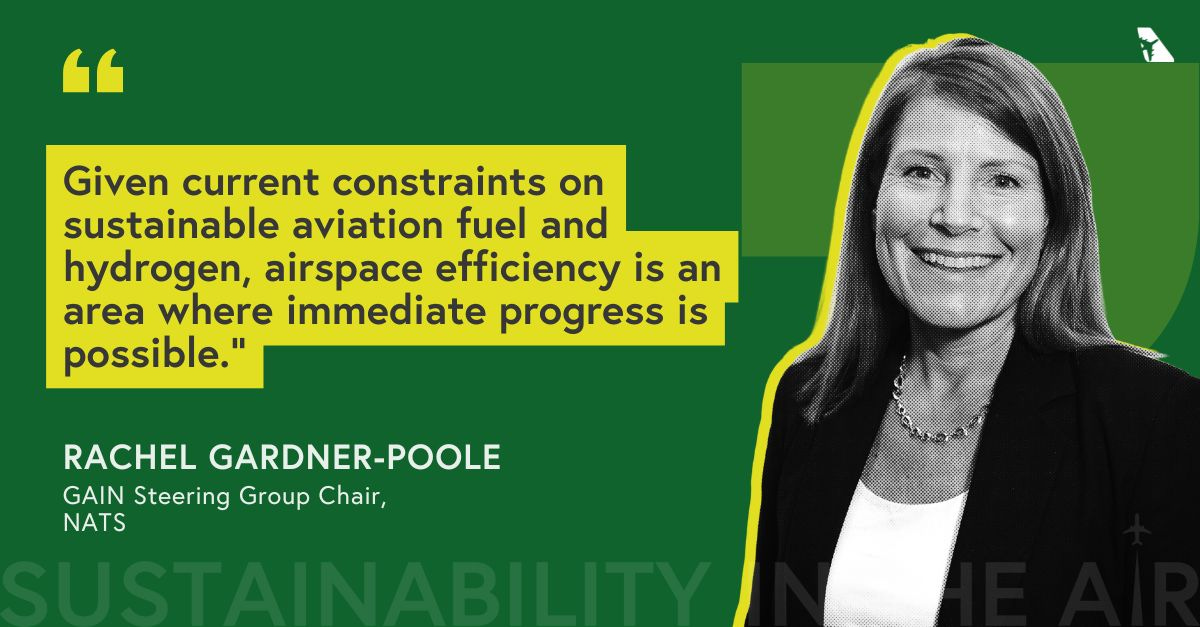
NATS has been regulated by the UK Civil Aviation Authority on efficiency and environmental performance since 2012, and has developed sophisticated tools to model real-world routes against optimum flight profiles, explains Gardner-Poole. Through GAIN, this expertise can now being applied at an international level.
On any long-haul flight, aircraft pass through multiple national airspaces, each managed by a different provider with its own constraints and optimisation practices. GAIN brings these ANSPs together to share insights and benchmark performance using a common metric.
In doing so, it seeks to address three persistent challenges:
Creating consistent measurement across borders;
Helping ANSPs demonstrate progress to governments and regulators;
And reducing the manual burden of data analysis through greater automation.
4 takeaways from the conversation
1. Establishing a common metric for airspace efficiency
A longstanding challenge in airspace management has been the lack of a common metric to measure airspace efficiency. Different countries and ANSPs rely on different metrics, making meaningful cross-border performance comparisons difficult.
GAIN addresses this using the methodology NATS has refined over the years: comparing actual flight paths against an optimum baseline.
“You could map out what the ideal, realistic route would be from A to B, including considerations such as continuous descent,” Gardner-Poole explains. “It involves identifying the optimum flight path, comparing it with what was actually flown, and then developing an efficiency metric based on that comparison.”
GAIN also displays CO2 emissions within specific airspace by individual airline, route, and sector. This granular view enables ANSPs to identify “hotspots” where emissions are particularly high and interventions could have the greatest impact.
For many ANSPs, particularly smaller organisations with limited capacity, this level of insight would otherwise be out of reach. “Often these air navigation service providers have limited resources and limited time with their teams,” Gardner-Poole notes. “GAIN reduces their burden by taking in the data and automatically populating dashboards.”
2. Breaking down communication barriers between airlines and ANSPs
Many persistent inefficiencies in aviation operations stem not from technical constraints, but from misaligned assumptions. Airlines often file flight plans based on what they believe air traffic controllers require, while controllers approve those plans assuming they reflect airline preferences. Once established, these patterns can continue unchanged for years, says Gardener-Poole.
GAIN’s dashboard helps overcome these misconceptions by providing clear evidence of inefficiencies. It allows ANSPs to ground conversations in data, showing how operational choices translate into fuel burn and emissions.
“For example, it might flag issues related to continuous descent, highlighting that an airline is generating more emissions during descent than most others,” Gardner-Poole explains.
The tool also supports benchmarking by individual airline, specific route, or sector, allowing ANSPs to tailor discussions to their audience. Detailed operational data can underpin technical conversations with airline performance teams, while higher-level summaries support more strategic discussions with senior leaders.
3. Building a voluntary global collaboration
GAIN has been designed as a voluntary collaboration, growing through participation rather than mandate. Its development is guided by five founding members, which include skeyes in Belgium, CAAM in Malaysia, AZANS in Azerbaijan, ATNS in South Africa, and NATS in the UK.
The members meet regularly every four to six weeks to shape how the tool evolves. The collaboration also provides a forum for shared learning, where members can exchange regional insights and host guest speakers on topics such as non-CO2 effects and contrails, areas where operational understanding continues to evolve.
Looking ahead, GAIN aims to engage around 40% of the world’s nearly 160 air navigation service providers by 2030, says Gardner-Poole. Reaching that scale would require participation from some of the largest ANSPs globally, including those in countries such as Canada, the United States, Australia, and New Zealand.
4. From small efficiency gains to system-wide impact
GAIN’s potential impact becomes clear even when assessed using deliberately conservative assumptions. Across the current five founding members, efficiency improvements could deliver savings of more than 450,000 tonnes of CO2 each year, says Gardner-Poole.
These estimates are based solely on tactical improvements, which typically deliver efficiency gains in the range of 1-1.5%. Scaled to wider participation, however, the cumulative effect becomes more pronounced.
“With our current five founding members, CO2 savings amount to more than 450,000 tons per year. If the participation increases to 90 organisations, those savings would rise to about 9 million tons annually, based on efficiency gains of just 1-1.5%.”
As participation grows, the benefits extend beyond individual airspaces. Shared learning and benchmarking allow early adopters to demonstrate what is achievable, creating momentum for others to follow, and reinforcing the value of a common approach.
Get our new book
Our new book Sustainability in the Air: Volume Two is now available for purchase on Amazon. Learn more about the startups, strategists, and sceptics working to close the gap between growth and green ambition.
‘Sustainability in the Air’ is the world’s leading podcast dedicated to sustainable aviation. Through in-depth conversations with top aviation leaders, we break through the clutter and provide a clear roadmap for a net-zero future.


