

#Sustainability40: Airbus greenlights 100 seat hydrogen regional jet after feasibility success & more
Weekly Round-up - 27/03/26

Each Friday, we publish a round-up of the most important stories on sustainable aviation. You can see previous editions of #Sustainability20 here.
Industry Updates
American Airlines and Google cut contrail formation by 62% across 2,400 transatlantic flights using AI rerouting, reducing warming impact by up to 69% with no statistically significant increase in fuel burn.
Singapore’s CAAS deferred its SAF Levy from April 2026 to October, pushing the 1% SAF mandate back to 2027, citing the ongoing Middle East conflict’s disruption to aviation fuel markets.
IATA has called on the EU to reform its Emissions Trading System, urging full CORSIA implementation for all international flights, a SAF book-and-claim mechanism under the ETS, and reinvestment of ETS revenues into decarbonisation.
Airlines for Europe told the EU that aviation regulatory costs have tripled since 2014 to €15.5 billion annually, demanding ETS costs align with CORSIA and calling for the eSAF sub-mandate to be postponed.
Japan Airlines became the first commercial airline to make a large-scale retirement of Gold Standard CORSIA credits, surrendering 180,000 EEUs sourced from cookstove projects in Malawi and Tanzania, retired via Shell.
UK aviation body Sustainable Aviation launched a £2 million Advanced Market Signal at the Sustainable Skies World Summit, committing members to purchase greenhouse gas removal credits to help scale nascent CDR markets for aviation’s net zero gap.
IATA projected global air travel will exceed 20.8 trillion revenue passenger kilometres by 2050 — more than double 2024 levels — at a 3.1% annual growth rate, with Asia-Pacific (3.8%) and Africa (3.6%) leading growth.
OMV and Technical University of Leoben have established a one-of-a-kind research SAF research facility, to study sustainable aviation fuels using simulation methods and machine learning to support development and scale-up.
British Airways has proposed a pilot bonus, worth up to 1% of basic salary, contingent on crews collectively cutting CO2 emissions by 60,000 tonnes above 2025 levels, with a British Airline Pilots’ Association vote scheduled for late April.
CLIMATE WATCH: US has caused $10tn worth of climate damage since 1990, research finds - The Guardian
A Stanford University study published in Nature found US greenhouse gas emissions since 1990 have caused $10 trillion in global GDP damage, ahead of China’s $9 trillion, with India absorbing $500 billion of US-attributable losses.
Infrastructure and operational efficiencies
Fraport secured €2.55 million in EU CEF funding for Frankfurt Airport’s Greenvolt project, covering 322 new EV charging points, ground power upgrades at nine remote aircraft stands, and battery storage linked to runway solar panels.
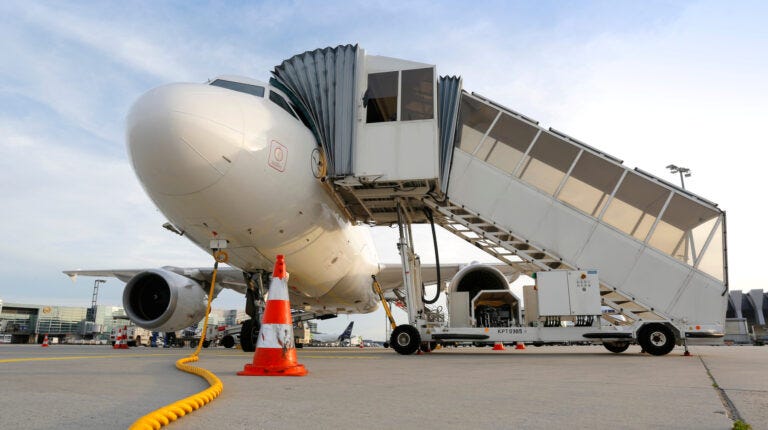
Fraport secured a 15-year, 85-megawatt offshore wind PPA with EnBW’s He Dreiht wind farm from mid-2026, complemented by a 17.4 MWp vertical photovoltaic installation along Runway 18 West, targeting net zero Scope 1 and 2 by 2045.
Heathrow’s 2025 sustainability report showed aircraft emissions fell 7% from 2019 levels, ground carbon emissions dropped 18%, overall waste reduced 3%, and 3.1% of departing flights used sustainable aviation fuel.
Miami International Airport and American Airlines are developing a $1 billion Concourse D60 expansion adding 17 new gates, breaking ground in 2027 and completing by 2030, as part of Miami-Dade’s wider $9 billion M.I.A. Plan.
Leeds Bradford Airport launched its “Together for Tomorrow” sustainability strategy, targeting Scope 1 and 2 net zero by 2030, backed by a £200 million terminal transformation and building on a 74% emissions reduction achieved since 2018.
Cologne Bonn Airport is investing €33.25 million across five sustainability projects — including 38 EV chargers, 16 pre-conditioned air units, and 15 electric ground power units — supported by €9.75 million in EU CEF funding, targeting 6,000 tonnes of annual CO₂ savings.
Venice Airport, San Francisco International, and Frankfurt’s Fraport outlined distinct energy strategies — agrivoltaic solar, full GSE electrification with 500 charging ports, and an 85 MW offshore wind PPA — at an International Airport Review webinar.
Sustainable Aviation Fuel (SAF)
Octopus Energy Generation is planning up to $6 billion investment in a Nova Scotia biomass-to-SAF facility at Goldboro, producing 165,000 tonnes of SAF annually from 750,000 tonnes of forestry waste for European markets, targeting 2031 operations.
EcoCeres launched “Project Spark” SAF pilot in China with five aviation partners, using Zhangjiagang-produced waste-based SAF to refuel commercial flights at Chengdu Shuangliu Airport on 16 March, with credits tracked via the AnchorTrace platform.
Praj Industries is expanding India’s biofuel ecosystem beyond ethanol into SAF and compressed biogas through integrated biorefineries, as India’s 85% crude oil import dependency intensifies the push for domestic alternatives amid geopolitical tensions.
More than 50 organisations from the SAF Coalition gathered on Capitol Hill on 25 March to advocate for policy support, following a year in which US domestic SAF production more than doubled.
Rolls-Royce has partnered with UK firm Equilibrion to explore using its small modular reactors to produce sustainable aviation fuel at commercial scale, offering a reliable, low-carbon alternative to intermittent renewables for energy-intensive SAF synthesis.
EPA Administrator Lee Zeldin confirmed the Renewable Fuel Standard “Set 2” rule would be finalised in March 2026, after its delivery to the White House Office of Management and Budget on 25 February following a public comment period.
Middle East conflict drove California SAF prices to a record $8.85 per gallon in early March as Strait of Hormuz tanker flows were disrupted, prompting US producer XCF Global to advocate for domestic waste-based SAF as an energy security solution.
India’s SAF Association urged the Ministry of Petroleum to include used cooking oil under the Extended Producer Responsibility framework, arguing that capturing 15% of commercial UCO could meaningfully boost domestic sustainable aviation fuel production.
Washington State University validated Universal Fuel Technologies’ Flexiforming process, which converts HEFA naphtha byproduct into aromatic kerosene; a 16:84 blend with HEFA SAF met all jet fuel performance standards without any fossil-based blending.
Technip Energies has acquired a stake in Verso Energy’s DEZiR project, a green hydrogen-based e-SAF facility in France expected to produce 80,000 tonnes of synthetic aviation fuel annually when it starts operations in 2030.
Southern Energy Renewables announced a $1.4 billion biomass-to-green methanol and SAF facility in Louisiana’s St. Charles Parish, converting wood-waste into fuel and creating 120 direct jobs averaging $97,267, plus 394 indirect positions.
DHL Express partnered with Malaysia Aviation Group to reduce cargo emissions using book-and-claim SAF, building on MAG’s 2025 two-week SAF trial uplift on the Kuala Lumpur–London route at KLIA.
A SXSW 2026 fusion panel projected commercial fusion power arriving in the 2040s — precisely when power-to-liquid SAF must scale — while noting SHINE Technologies already uses fusion neutrons commercially to inspect jet engine turbine blades.
New technology: Electric and Hydrogen
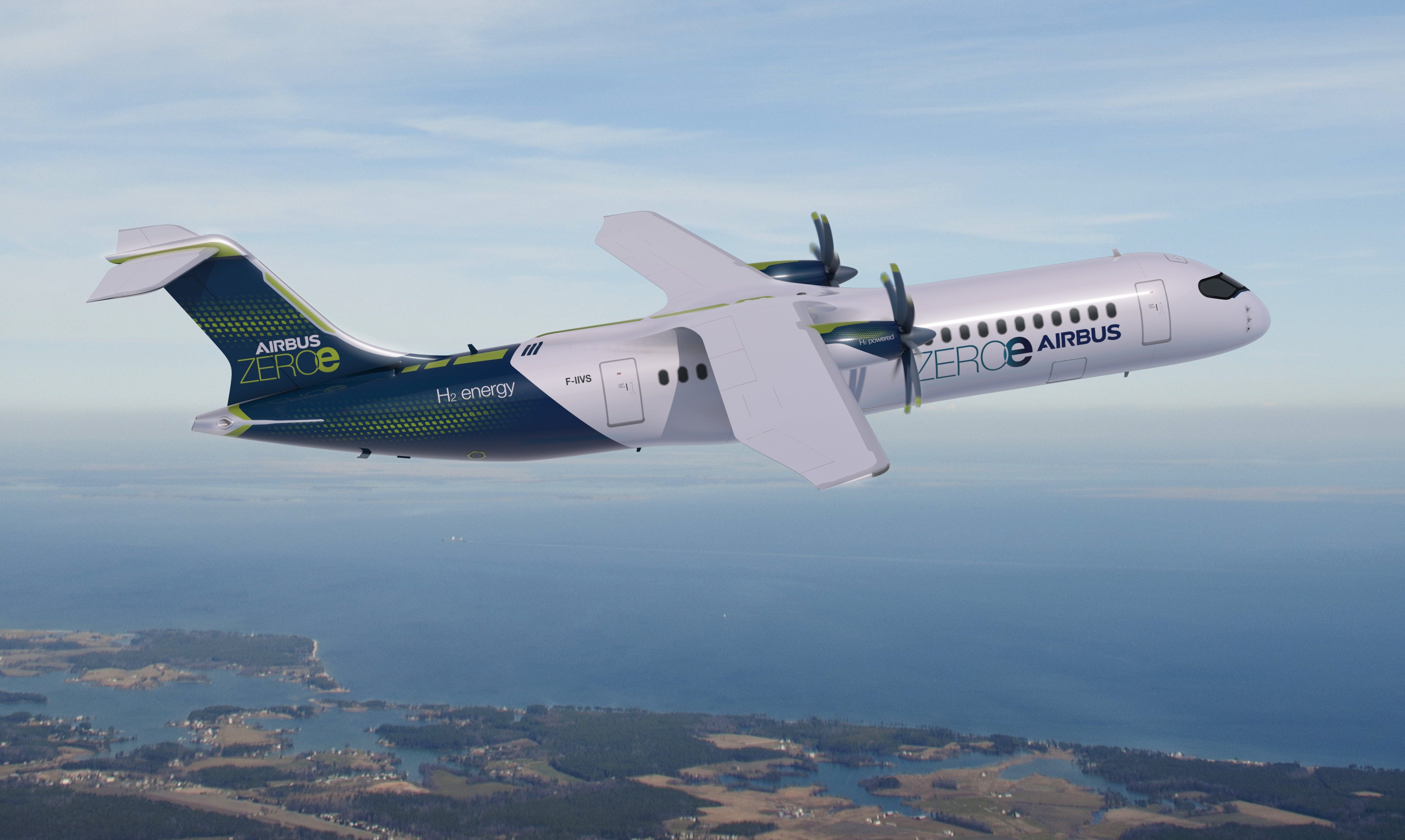
Airbus has confirmed technical feasibility of its ZEROe 100-seat hydrogen fuel cell regional jet, featuring four 2-megawatt under-wing pods running on liquid hydrogen at –253°C, with entry into service targeted for 2040–2045.
Eve Air Mobility flew its full-scale eVTOL prototype for Brazilian President Lula da Silva at Embraer’s Gavião Peixoto facility, having logged 35 flights and nearly 1.5 hours of total flight time since its December 2025 maiden hover.
3M announced an investment and collaboration with JetZero to develop a blended-wing aircraft aiming to reduce fuel use by up to 50%.
Joby Aviation’s piloted electric air taxi crossed San Francisco Bay and flew past the Golden Gate Bridge on 13 March, launching its 2026 Electric Skies Tour following White House eIPP selection for operations across 10 states.
The FAA published final special conditions for ZeroAvia’s hydrogen-electric ZA601 engine on 18 March, addressing Part 33 regulatory gaps for electric propulsion, despite ZeroAvia having cut roughly half its workforce in January due to funding shortfalls.
Loganair flew a BETA Technologies ALIA CX300 from Edinburgh to Dundee and then Inverness on 19 March, becoming the first UK commercial airline to operate an all-electric flight, during a two-week Royal Mail freight demonstration.
French startup Beyond Aero completed the Preliminary Design Review of its hydrogen-electric business jet, confirming that propulsion, hydrogen storage, aerodynamics, and avionics systems have reached the maturity required for a certifiable architecture.
Collins Aerospace completed the EU Clean Aviation Joint Undertaking’s HECATE project, achieving Technology Readiness Level 5 for high-voltage electric power distribution systems for hybrid-electric regional aircraft, using digital twin simulations throughout.
EU Horizon Europe aviation projects FlyECO and TRIATHLON signed a non-disclosure agreement to share research data on hydrogen-electric propulsion, with FlyECO combining solid oxide fuel cells and hydrogen-fuelled gas turbines under DLR coordination.
Bristol-based eVTOL developer Vertical Aerospace warned its £69 million year-end 2025 cash balance may only last into mid-2026, despite completing hover, vertical, and wingborne piloted flight milestones with its Valo aircraft during 2025.
Surf Air Mobility signed a purchase agreement for 25 BETA Technologies Alia CTOL electric aircraft — with options for 75 more — to launch commercial electric aviation in Hawaii, starting with inter-island cargo before passenger services.