

Why Uzbekistan could become a world-leading SAF hub
A $6 billion project in Central Asia raises the question: are we looking for SAF in the wrong places?

⚡In a nutshell
Uzbekistan’s $6 billion SAF mega-project could make Central Asia a world leading production hub, challenging US/Europe/Middle East dominance.
The project is hybrid AtJ (sorghum/camelina ethanol) + e-SAF (biogenic CO2 + 2.4GW green H2) targeting 400k+ tonnes/year SAF.
It is backed by Presidential Decree, while the country has cheap solar (300 sunny days) and low costs. However challenges include feedstock scale, water limits and double-landlocked logistics hurdles.
Central thesis: Conventional SAF hotspots may not completely define future production; regions with cheaper inputs could reshape geography despite logistics.
As mandates grow in demand markets, regions like Uzbekistan might outcompete proximity if transport premiums stay manageable.

When the sustainable aviation fuel (SAF) industry maps out where large-scale production will happen, the names usually cited include places like Texas, Spain, the UAE and Chile.
One name you normally don’t hear mentioned is Uzbekistan.
Thats about to change, following the announcement of a $6 billion project, that, if realised, will become one of the world’s biggest SAF projects, with fuel produced at an industrial scale via both the alcohol-to-jet (AtJ) and eSAF pathways.
This comes as the country’s fundamentals suggest it has many of the ingredients needed to become a major SAF centre. Here’s why:
First, there’s the solar potential. Uzbekistan averages 300 days of sunshine per year, with solar irradiation comparable to that in Spain. By the end of 2025, the country had installed 8 GW of renewable capacity, 31% of its total, and is targeting 25 GW of solar and wind by 2030.
Second, land is abundant, and labour costs are lower than in Europe. And crucially, a region that spent decades watching cotton monoculture contribute to one of the world’s worst ecological disasters, the drying of the Aral Sea, is now actively looking for agricultural alternatives.
That combination: Cheap renewable energy for green hydrogen, available agricultural land, low construction costs and strong political backing, forms the logic behind what would be one of the largest SAF schemes anywhere on earth.
The project: AtJ meets e-Fuels
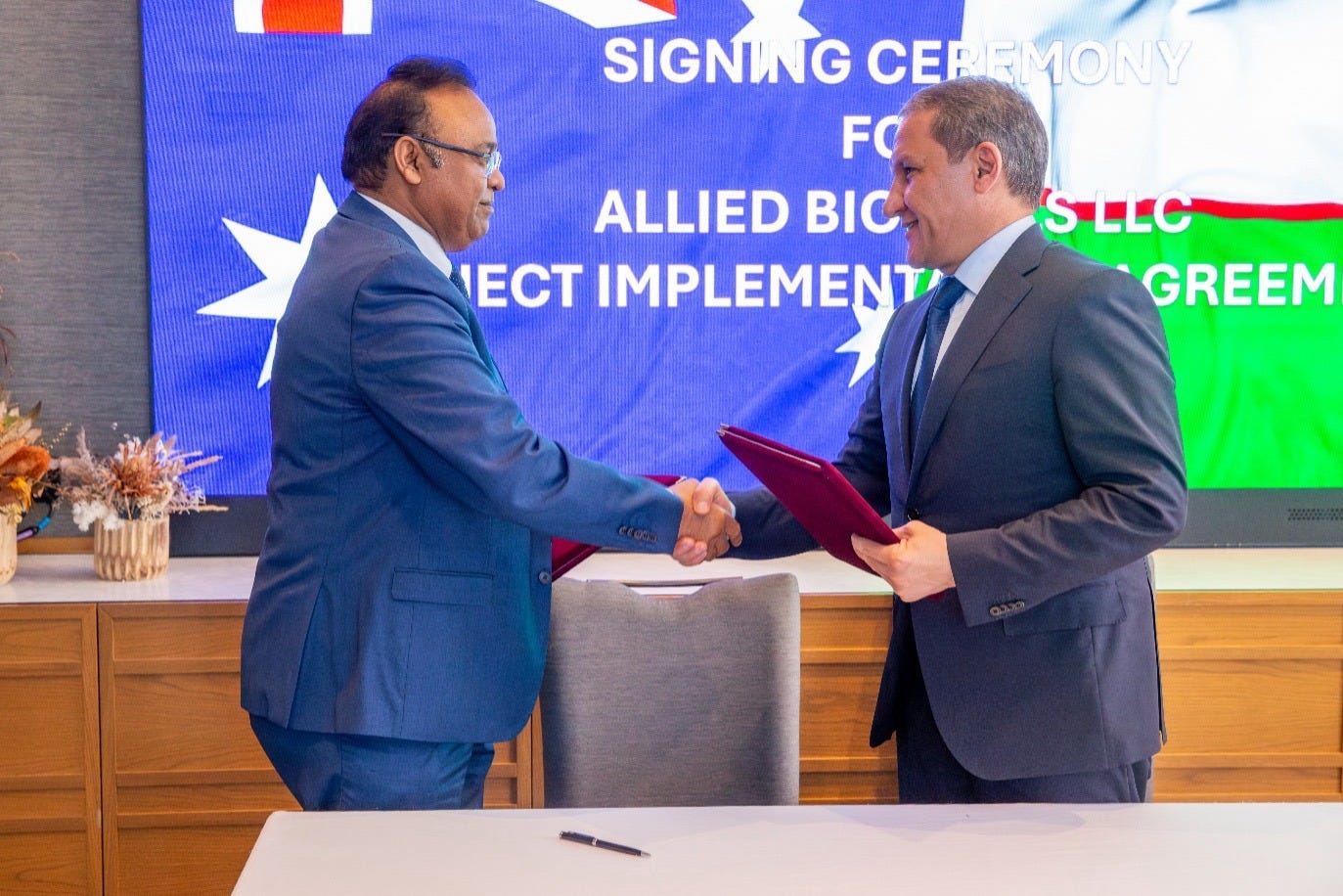
This month, Allied Biofuels, a Perth, Australia-headquartered developer, signed a binding Project Implementation Agreement with the regional government of Khorezm in northwestern Uzbekistan, backed by a Presidential Decree granting Special Economic Zone status with tax exemptions and customs incentives.
The total projected investment represents a colossal sum — $6.08 billion. Final investment decision is targeted for late 2026.
The facility’s design is a hybrid of two SAF pathways:
The first is alcohol-to-jet. Using first-generation ethanol technology from India’s Praj Industries, the plant would convert locally grown feedstock, primarily sorghum, alongside camelina and agricultural residues, into approximately 293,000 tonnes per year of ethanol. That ethanol would then be converted into around 160,000 tonnes of SAF and 5,000 tonnes of green diesel annually.
The second pathway, e-fuels, expands the scale dramatically. Biogenic CO2 captured during ethanol fermentation would be combined with green hydrogen, produced using up to 2.4 GW of Plug Power PEM electrolysers powered by 4.45 GW of dedicated renewable energy, to produce roughly 257,000 tonnes per year of electro-SAF (e-SAF).
This would result in a total projected output: over 400,000 tonnes per year of SAF and e-SAF combined. If built at that scale, it would rank among the largest such facilities globally.
The feedstock choices are worth noting. Sorghum is salt-tolerant and has been shown in research trials in Khorezm to perform well on marginal, salinised soils. This is exactly the kind of degraded land that cotton and wheat increasingly struggle on. Camelina, an oilseed native to Central Asia, is drought-tolerant and can grow on land unsuitable for food crops. Both choices avoid the food-versus-fuel conflict.
The questions
The fundamentals and numbers may be impressive. However, a project of this scale in a non-obvious geography does raise a number of questions.
First of all, the feedstock requirement, nearly 5,800 tonnes of biomass per day, is enormous, and no sorghum supply chain exists in Uzbekistan at anything close to this volume. Khorezm’s irrigated cropland covers around 270,000 hectares in a region where agriculture already consumes 90% of available water.
Building an entirely new feedstock ecosystem here is not trivial.
Then there is the logistics challenge. Uzbekistan is one of only two double-landlocked countries on earth. Every tonne of SAF produced would need to cross at least two national borders to reach a seaport, let alone the airports in Europe, the Middle East or Asia where mandates and / or demand exist.
The project also depends on 2.4 GW of electrolysers from Plug Power, a company that has faced well-documented financial headwinds, including a suspended Department of Energy loan programme and class action lawsuits. And the 4.45 GW of renewable energy the facility would require exceeds Uzbekistan’s total installed solar capacity as of early 2025.
The bigger picture
Whether or not this specific project reaches a final investment decision, the underlying thesis deserves attention.
The economics of SAF production are driven by factors such as renewable energy, feedstock, labour and construction costs, land costs and availability and in the case of e-fuels, green hydrogen. These can, in many cases, be sourced more cheaply in places like Central Asia, North Africa and parts of Latin America than in the established aviation markets of Europe and North America.
As a result, as a recent SAF Investor London panel chaired by SimpliFlying founder and CEO Shashank Nigam found, areas of the world including the so-called Global South represents an enormous, untapped SAF opportunity.
SAF mandates, however, are being set in established markets. If the cheapest production happens thousands of miles from where the fuel is needed, the question becomes whether the logistics cost of transporting fuel from low-cost production regions to high-demand markets is less than the input cost premium of producing closer to demand.
However, the fact that a $6 billion project with Presidential backing is being developed in Uzbekistan, suggests that the geography of SAF production could end up looking different from what the industry currently expects.