


In this episode of our ‘Sustainability in the Air’ podcast, Julia Fidler, former Director of Market Development for Energy, Connectivity, and Sustainability at Microsoft, speaks with SimpliFlying’s CEO Shashank Nigam, and shares how the company built partnerships that are reshaping corporate approaches to Scope 3 emissions.
After nearly two decades at Microsoft, Fidler is stepping into the role of Executive Director at RSB, bringing with her a practitioner’s understanding of how companies turn climate goals into real progress.
Here are the key highlights of the conversation:
Why scope 3 business travel unlocks the bigger challenge (8:16)
Building the Microsoft, Alaska Airlines and Twelve partnership (12:29)
The IAG collaboration and supplier engagement (19:19)
Microsoft’s technology evaluation approach (22:19)
Carbon removal and the remove-reduce-replace framework (23:43)
Balancing business travel with demand management (27:13)
Transitioning to RSB: sharing the Microsoft playbook (28:42)
Rapid Fire! (33:58)
Keep reading for a detailed overview of the episode.
Why Microsoft’s scope 3 approach matters
For most companies, Scope 3 emissions make up the bulk of their carbon footprint, yet they remain the hardest to tackle. As Fidler points out, “For Microsoft, around 98% of the emissions are Scope 3.”
Within Scope 3, business travel, which is categorised as Scope 3.6, became an early focus for Microsoft not because it was the largest contributor, but because it was one of the few areas that could be measured with some accuracy. “Travel agencies could provide you with reports to show you how far you travelled, which class you travelled in,” Fidler says. That data made travel one of the first categories where Microsoft applied its internal carbon fee, creating a way to manage emissions and fund exploratory work.
As Fidler dug deeper, she began to see aviation fuel as a thread that runs through much more than employee travel. “There’s really nothing that we buy that doesn’t have some type of transportation connected to it. So whether it’s employees or whether it’s logistics, you’re moving either people or goods at some point in time.”
“When you look at corporate emissions, the vast majority sits in Scope 3. If you want to make real progress on those 90%+ Scope 3 emissions, you eventually reach sectors like transportation and fuel use. These are commonly labeled hard to abate, but they are central to the problem. They are exactly the areas we have to confront if we want meaningful reductions.”
This perspective helped shape Microsoft’s strategy to support sustainable aviation fuels (SAF), recognising that advancing low-carbon aviation solutions could create benefits that extend well beyond the company’s own operations.
4 takeaways from the conversation
1. Creating internal mechanisms to fund market-building work
One of Microsoft’s most innovative programs was the internal Sustainability Grant Program, which helped employees explore early stage sustainability solutions long before clear business cases existed.
Funded through Microsoft’s carbon fee, the program acted as seed capital for new ideas and partnerships. This mechanism made it possible to investigate emerging technologies and understand their risks and opportunities.
“It was there for us to pitch internally to then be able to secure funding to use externally,” Fidler explains. The grants enabled her to access consulting advice and develop partnerships with organisations like RSB, RMI and the Environmental Defence Fund. “It was like seed funding, you could say, for internal projects.”
Microsoft’s internal grant program exemplifies how large organisations can create space for innovation within existing structures, providing both financial resources and institutional backing for employees to explore new decarbonisation pathways.
2. Supporting the most expensive pathways through a green premium
In 2022, Microsoft, Alaska Airlines and carbon transformation company Twelve signed a Memorandum of Understanding (MOU) to collaborate on advancing the market for SAF. The partnership is especially notable because it backs one of the most costly SAF pathways: e-fuels.
When asked why Microsoft would choose the costliest option, Fidler is direct: “If Microsoft can’t go for the most expensive, then I wonder who can.”
Her view is grounded in the green premium concept, which she explored early in her sustainability work. The principle is simple: emerging technologies do not scale unless early customers are prepared to pay more.
Many companies now understand that a cost is attached to buying cleaner alternatives. “Green premium concept is not now unfamiliar to people,” she explains. The question is who has the capacity and responsibility to lead. “Those that can do more should. Let’s hold them accountable to that.”
She also points out that contributing to a green premium is not only about cash. “Sometimes it’s through partnership that you find a way to break down that cost. What does it mean to each party? What do they bring? And is it always finance or is it other skills and experience?”
The partnership between Microsoft, Alaska Airlines and 12 demonstrated this principle. Each party contributed different capabilities: Microsoft’s willingness to pay premium prices, Alaska’s operational expertise, and Twelve’s technology. “It starts fundamentally at a willingness to try and an awareness of the need to do that,” Fidler reflects.
3. Balancing demand management with technological solutions
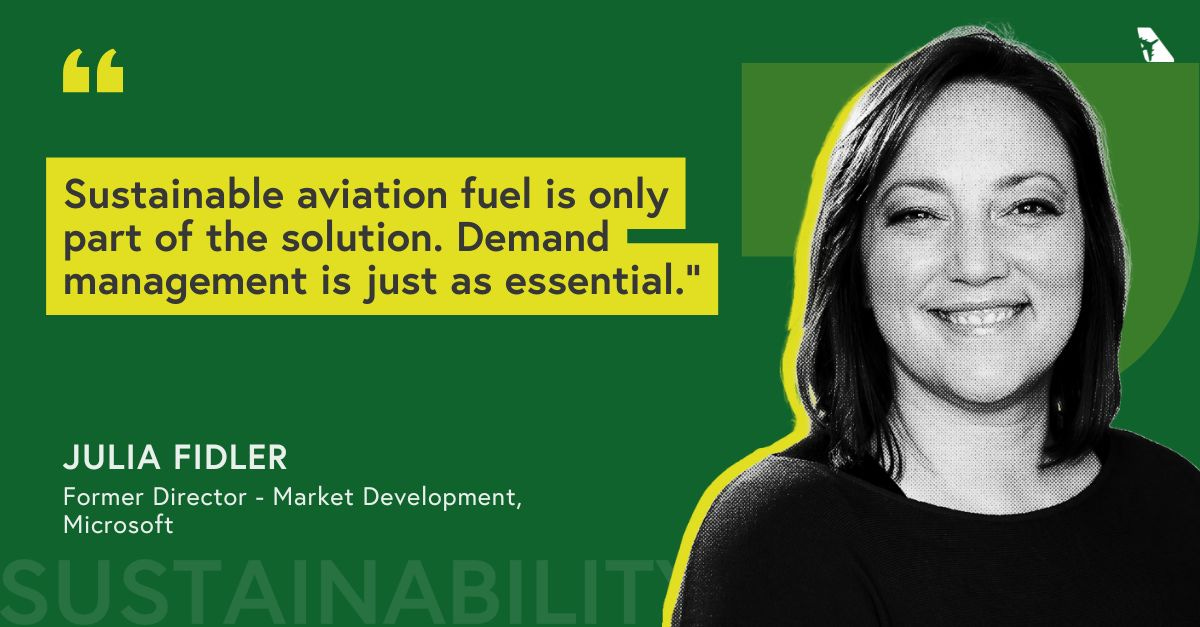
Fidler emphasises that technological solutions like SAF must work alongside demand reduction, not replace it. This balance remains essential even as companies invest heavily in new fuel pathways.
Reflecting on post-COVID travel patterns, Fidler notes: “That was the proof, wasn’t it, that we can still do business without flying. We just need to remember those lessons and keep our balance.”
This extends to Microsoft’s broader carbon strategy, which Fidler describes as “remove, reduce and replace.” Remove carbon already emitted, reduce current emissions wherever possible, and replace fossil fuels with sustainable alternatives.
Employee engagement further supports this balance. Through booking tools, personalised communications and active sustainability communities, Microsoft helps employees understand impact and make informed choices about when travel is necessary.
4. Bringing corporate expertise to standards and governance
Fidler’s move to RSB marks a natural extension of her work at Microsoft. Having relied on standards as an end user, she brings a clear understanding of their value and the reassurance they provide when companies enter complex sustainability agreements.
“From an end user’s perspective, entering into agreements involves risk, especially reputational risk,” she says. RSB helped her navigate that early on. “I valued their work because it directly supported what I was doing at Microsoft, and now I want to share that value with others.”
The timing matters. Many corporates have already committed to ambitious climate goals but are now grappling with the practical steps required. As Fidler puts it, “There are many companies that have already built that business case. They have already set targets. And now they just need to know how to achieve those.”
By bringing her experience at Microsoft to RSB, Fidler hopes to help other organisations navigate Scope 3 decarbonisation with the same level of discipline and ambition. That means supporting business case development, sharing lessons from leaders and strengthening the integrity of sustainability claims through robust standards.
Get our new book
Our new book Sustainability in the Air: Volume Two is now available for purchase on Amazon. Learn more about the startups, strategists, and sceptics working to close the gap between growth and green ambition.
‘Sustainability in the Air’ is the world’s leading podcast dedicated to sustainable aviation. Through in-depth conversations with top aviation leaders, we break through the clutter and provide a clear roadmap for a net-zero future.


