

#Sustainability20: World’s first megawatt-class Hydrogen turboprop engine completes maiden flight in China & more
Weekly Round-up - 10/04/26

Each Friday, we publish a round-up of the 20 most important stories on sustainable aviation. You can see previous editions of #Sustainability20 here.
Industry Updates
The aviation industry has not yet decided who will pay for net zero, as airlines baulk at costs, investors demand policy certainty, and mandate-driven SAF premiums have proven unexpectedly expensive.
US SAF production has tripled, but industry insiders fear a decline without renewed tax credits, as the fuel struggles to compete with renewable diesel for limited refinery space.
Estuaire has partnered with Air France to address the climate impact of contrails, advancing scientific understanding and developing practical solutions to reduce aviation’s environmental footprint and support the industry’s transition.
CLIMATE WATCH: ‘Non-survivable’: heatwaves are already breaching human limits, with worse to come, study finds - The Guardian
Scientists have found that recent heatwaves created non-survivable conditions for older people, even without reaching the theoretical wet-bulb limit, suggesting humans are more vulnerable than previously thought.
Infrastructure and operational efficiencies
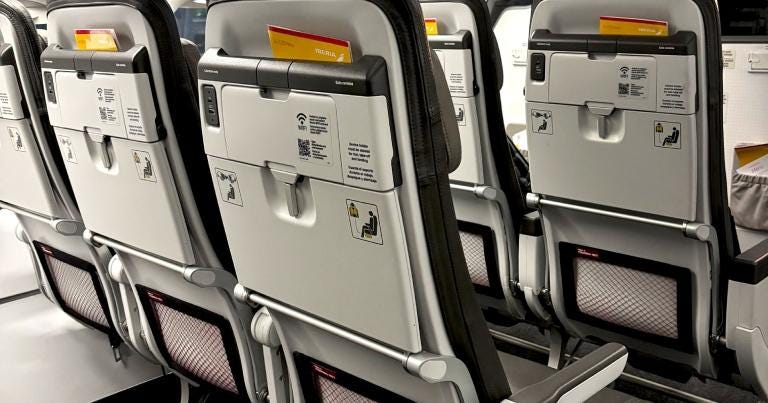
Iberia has partnered with RECARO to trial sustainable seating on an A320neo, using upcycled fishing nets and real wood inlays to bring circular design into the aircraft cabin.

Jet2.com has applied lightweight paint to over 80 aircraft, saving nearly a quarter of a million litres of fuel annually and cutting carbon emissions by more than 500 tonnes.
Sustainable Aviation Fuel (SAF)
Sora Fuel has raised $14.6 million to scale a technology that turns air, water and renewable energy into jet fuel, aiming for price parity with fossil kerosene.
Google has joined Amex GBT and Shell on the Avelia blockchain registry, using a book-and-claim model to buy SAF’s carbon savings even when the fuel is not physically available at its departure airport.

XCF Global has teamed up with Axens to deploy a modular refinery design, pairing its standardised blueprint with Vegan technology to accelerate SAF production worldwide.
Oiltek has signed a $350 million deal to build a 300-tonne-per-day SAF plant in Sabah, an order that dwarfs its existing RM350 million book and deepens its role in the value chain.
American scientists have developed a single-step catalyst to turn ethanol directly into jet fuel, and Gevo is now scaling the process to lower SAF costs significantly.
Turkish Airlines has approved a $42 million investment for a 40% stake in a Turkish biofuel producer, moving from SAF consumer to equity partner in production capacity.
Finboot has signed with Acelen Renewables to trace macauba-oil SAF from farm to fuel, using blockchain to meet strict EU and US sustainability regulations for Brazilian exports.
New technology: Electric and Hydrogen
China has successfully flown the world’s most powerful hydrogen turboprop on a 7.5-tonne uncrewed cargo plane, marking a major milestone in its green aviation push.

EVIO has unveiled a 76-seat hybrid-electric regional aircraft, backed by Boeing and Pratt & Whitney Canada, with first deliveries planned for the early 2030s.
Vertical Aerospace has completed the first piloted transition of its full-scale eVTOL, taking off vertically and accelerating into wingborne flight at its Gloucestershire test site.
Eve Air Mobility has passed 50 successful test flights with its full-scale eVTOL prototype, gathering critical data as it moves towards certification and conforming prototypes.

Joby has teamed up with Air Space Intelligence to use AI for airspace coordination, aiming to integrate its eVTOL taxis seamlessly into the busy US National Airspace System.
Aurora Flight Sciences has helped design Wisk’s autonomous Generation 6 aircraft, providing critical battery, guidance and structural engineering to enable its first flight.
The FAA has published final special conditions for ZeroAvia’s electric engine, a major step towards certifying its hydrogen-electric powertrain for 10-20 seat aircraft.
Blue Spirit Aero has validated its hydrogen propulsion pod in high-altitude winter tests, clearing the way for flight testing of its Dragonfly light aircraft demonstrator.